10 Dec 2007


Ethics of Open Access to Biomedical Research
Philosophy, Ethics, and Humanities in Medicine | Abstract | 1747-5341-2-31 | Ethics of open Access to biomedical research: Just a special case of ethics of open access to research
.."Most research is funded so as to be conducted and published, by researchers, in order to be taken up, used, and built upon in further research and applications, again by researchers (pure and applied, including practitioners), for the benefit of the public that funded it -- not in order to generate revenue for the peer-reviewed journal publishing industry (nor even because there is a burning public desire to read much of it). Hence OA needs to be mandated, by researchers' institutions and funders, for all research.."
Database of Web 2.0 Applications
Office 2.0 Database is a listing of Web 2.0 Applications and their details.
9 Dec 2007
Reliability of journal impact factor rankings
BioMed Central | Abstract | 1471-2288-7-48 | Reliability of journal impact factor rankings
Decisions placed on journal impact factors are potentially misleading where the uncertainty associated with the measure is ignored.
8 Dec 2007
7 Dec 2007
MIDAS
About MIDAS
National Institute of General Medical Sciences established MIDAS, Modeling of Infectious Disease Agent Study, to investigate novel computational and mathematical models of existing and emerging infectious diseases.
5 Dec 2007
Video on RFID in Library
Found a video to illustrate how RFID is used in Library. It also shows how and what makes it work.
Census of India - Website
Census of India website provides comprehensive data up to State level free of cost for registered members (Free).
NKC on online educational resoureces
NKC for online educational resources to promote higher education, Today News - By Indiaedunews.net
NKC for online educational resources to promote higher education
Web is creating fresh opportunities - and challenges - for chemistry
Surfing Web2O
..The emphasis on user-generated content, shared amongst online social networks, is typical of Web 2.0, the umbrella term for the current evolutionary stage of the world wide web. In this 'social web', swamps of data could be powerfully linked together. Search engines can trawl it to pick out whatever another user asks for. And user 'tagging', together with underlying machine-readable descriptions, means that related information can be easily linked. For example, clicking on a molecule could eventually bring up not just a 3D picture and a list of properties, but also the related online articles, experiments, videos and blog posts that refer to it..
3 Dec 2007
IT now happens in India!!!!: Library NEXT
Fully functional Next Generation libraries now becoming reality in India. This I realized only last Saturday (1st December 2007).
I happened to visit NATIONAL SOCIAL SCIENCE DOCUMENTATION CENTRE-NASSDOC (ICSSR) at 35, Ferozeshah Road, New Delhi 110 001. They hosted a meeting of "Ranganathan Research Circle". After the meeting, the hosts took us for a visit of their library. Well I was fascinated to see latest technology working for their library.
An ordinary library user needs to have his / her RFID embedded library card to get hold and carry home a book of his/her choice. That too without having to come in personal contact with library staff.

The reader would be able to enter the library by swiping one's card at a special entry / exit automated gate.


I happened to visit NATIONAL SOCIAL SCIENCE DOCUMENTATION CENTRE-NASSDOC (ICSSR) at 35, Ferozeshah Road, New Delhi 110 001. They hosted a meeting of "Ranganathan Research Circle". After the meeting, the hosts took us for a visit of their library. Well I was fascinated to see latest technology working for their library.
An ordinary library user needs to have his / her RFID embedded library card to get hold and carry home a book of his/her choice. That too without having to come in personal contact with library staff.

Library Card
The reader would be able to enter the library by swiping one's card at a special entry / exit automated gate.

Automated Entry / Exit Gate
Once in the library, the user can search library catalogue. It is computerised and available in the form of an online database commonly known as OPAC - Online Public Access Catalogue. I found three terminal aesthetically placed in front of large banner depicting the utility of catalogue.

Library OPAC
Searching OPAC could be useful. But as we know, most users would browse through the stacks. This comes naturally to human mind. One can easily browse the library stack area with help of guides. These guides are full of colours with well thought out background and labels.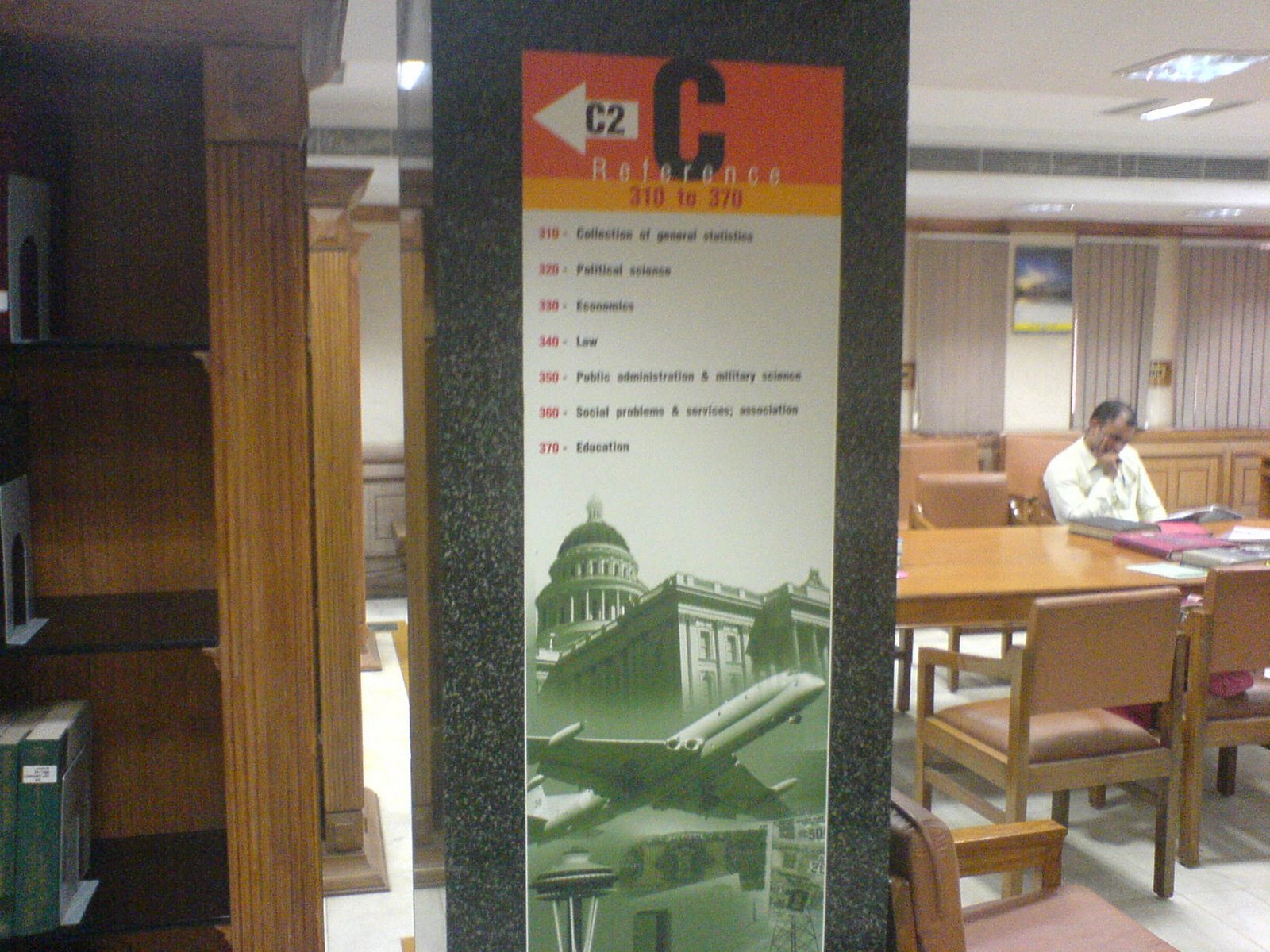
Stack Guides
Book stakes are made of wood that matches with the lovely atmosphere of the library. The shelves are made of think glass slabs. Not wonder sliding books to withdraw give a silky touch and hence protect book edges.
Stack Area

Book with RFID Tag
After getting a document of choice, one can choose to sit in a well lighted reading area. Few computer workstations are also available. So internet and electronic databases are are also available to readers.
Reading Area
Taking a book home is easy. Keep it with library card on the Automated Issue / Return Kiosk. Issue it and take it away. The automated security exit would not make any fuss.
Automated Issue / Return Kiosk
I hope Indian Libraries would soon witness adoption of such innovative technologies. The library staff would be spared from routine issue / return activities. Now they can devote their time and energy in some better activities. The 'stereo typed public perception' about librarians would also change.
So can we call such libraries as ATM Libraries?
1 Dec 2007
Some links to ejournals and open access to health science information
NN/LM Electronic Journals and Open Access
Selection of links to basic resources about electronic journals in the health sciences and about open access to health science information.
30 Nov 2007
Student activism: How students use the scholarly communication system
..If librarians offer workshops on getting published or on copyright, they should not miss the opportunity to emphasize the benefits of open access to the author. Early research suggests that student authors are particularly motivated by the accessibility and impact of their work.2 Discussing the dynamics, legal aspects, and market forces of scholarly communication will help students to make informed choices about sharing their research..
Subscribe to:
Posts (Atom)