Search Archive

28 Feb 2006

When will "Key Words" be replaced by "tags"

We know how Meta-data has replaced the term "Indexing" and "Cataloguing" in the last decade. Now it is turn of "Key Words" to be replaced by a term called "tagging". The only difference in these two terms is that "Key Words" are picked up from some standard vocabulary like MeSH by professionals; "tagging" is done by end users to bookmark and categorize an internet resource without any rules or vocabulary. The intention is to retrieve the "tagged" resource in future. But there is a Method in this Madness of tagging. The user indirectly registers a "vote" in favor of the resource being tagged. Such votes when collected on a service provider end can be used to indicate relative popularity of various resources. Del.icio.us is one of such service. This collective behavior is known "collaborative tagging".

Macgregor, George and McCulloch, Emma in their pre-print [accepted for publication] has suggested that Librarians and information professional researchers should take a leading role in research aimed at assessing the efficacy of collaborative tagging in relation to information storage, organization, and retrieval, and to influence the future development of collaborative tagging systems.

I am myself a regular user of Del.icio.us . I can keep links to my favorite articles, blogs, sites etc. and can access them from any computer on the web. I can share them easily by just by giving its URL . Moreover I can check up who else have tagged a particular resource of my interest. Exploring further I can find out from other's tags what all other resources could be of my interest.

Does not this sound similar to "Pearl Growing" in Science Citation Index? Such collaborative tagging sites also present what is known as "Tag Cloud" showing relative importance of tags in terms size and colour of fonts.

So when will be the term "Key Words" replaced by "tags"?.

27 Feb 2006

Will "Google Scholar" beat the "Web of Science" in future ?

Friends,

Just revisited Google Scholar last week. Noticed that it has improved a lot. Searched for "OpenMED@NIC" . It gave 925 hits. Not bad considering that OpenMED@NIC has around 1015 documents. What facinated me was that it presented link "Cited by" along with the hits. Clicking those showed all the articles citing an article in question in OpenMED@NIC.

No wonder Dean Giustini of Biomedical Branch Library, Vancouver Hospital Health Sciences Centre, writes in his blog an item - Google Scholar Rivals Web of Science comparing Web of Science with Google Scholar. He refers to an article by Daniel Pauly and Konstantinos I. Stergiou entitled "Equivalence of results from two citation analyses: Thomson ISI’s Citation Index and Google’s Scholar service. ETHICS IN SCIENCE AND ENVIRONMENTAL POLITICS, 2005:33–35 Published December 22.

"Citation counts were performed across a wide range of disciplines using both the Thomson ISI files and Google Scholar, and shown to lead to essentially the same results, in spite of their different methods for identifying citing sources. This has strong implications for future citation analyses, and the many promotion, tenure and funding decisions based thereon, notably because ISI products are rather costly, while Google Scholar is free."

However one thing irritates me - it shows the following text in hits of OpenMED@NIC.
"@import url(http://openmed.nic.in/eprints.css"
Google could have done better to render the CSS better from the Eprint based repository.

Indian library-cum-museum in the early 1960s


Directory of History of Medicine Collections: India (151)
Prof. S. Zillur Rahman established his personal library-cum-museum in the early 1960s. After founding of Ibn Sina Academy of Medieval Medicine Sciences in 2000 AD, this Library became a part of the Academy. The Academy is a non-political, non-governmental and non-profit organization registered under Indian Trust Act, 1882. It is also an accredited organization by the Ministry of Health and Family Welfare, Government of India.

Convert to PDF


Free PDF Converter - create high-quality PDF from any printable file type
Convert to PDF from any application by simply 'printing' to the PrimoPDF printer - it couldn't be easier! Within minutes, you can create high-quality PDFs by converting from Word, Excel, PowerPoint, and virtually any other printable file type.

24 Feb 2006

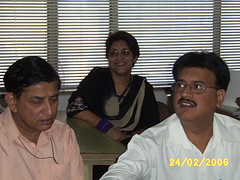
Me at Biomedical Information Retrieval Training.


biomedicaltrngfeb
Originally uploaded by esukhdev.
Myself guiding a Doctor to retrieve Biomedical Information during a training programme at NIC.

The "impact factor" revisited


The "impact factor" revisited
The number of scientific journals has become so large that individuals, institutions and institutional libraries cannot completely store their physical content. In order to prioritize the choice of quality information sources, librarians and scientists are in need of reliable decision aids. The "impact factor" (IF) is the most commonly used assessment aid for deciding which journals should receive a scholarly submission or attention from research readership. It is also an often misunderstood tool. This narrative review explains how the IF is calculated, how bias is introduced into the calculation, which questions the IF can or cannot answer, and how different professional groups can benefit from IF use.

22 Feb 2006

Open Access Movement and Libraries


DigitalKoans » Blog Archive » "Open Access and Libraries" Preprint
An in-depth look at the open access movement with special attention to the perceived meaning of the term “open access” within it, the use of Creative Commons Licenses, and real-world access distinctions between different types of open access materials.

Open Access and Libraries by Charles W. Bailey, Jr.


Open Access and Libraries by Charles W. Bailey, Jr.
An in-depth look at the open access movement with special attention to the perceived meaning of the term “open access” within it, the use of Creative Commons Licenses, and real-world access distinctions between different types of open access materials.

LIS blogs to follow in 2006

20 Feb 2006

Open access journals


Open access journals have the following characteristics: (1) they are scholarly, (2) they utilize quality control mechanisms like those of conventional journals (e.g., editorial oversight and copy editing), (3) they are digital; (4) they are freely available, (5) they may allow authors to retain their copyrights, and (6) they may use Creative Commons or similar licenses.

OpenMED@NIC now has more than One Thousand documents

Dear Friends,

Biomedical Archive - OpenMED@NIC now has more

than One Thousand documents.

in future, more and more authors would
archiving their published and useful research output here.

has been proved time and again that visibility of research improves
impact. No wonder why more and more journals are now allowing
authors to self-archive their papers.

17 Feb 2006

Web based online spreadsheets

Some Web based online spreadsheets

1 - iRows http://www.irows.com/xo/Welcome.do />
2 - Makesearchable http://makesearchable.com/ />
3 - TrimSpreadsheet http://trimpath.com/project/wiki/TrimSpreadsheet />
4 - Num Sum http://www.numsum.com/ />

Publi.sh


Disposable feeds for personal and group use by Publi.sh!
Publi.sh is the easiest possible way to create a web feed for personal or group use...


* Create a feed for personal reminders.

* Create a feed for updating team members, friends or family.

* Create a podcast feed.

* Create a feed companion to your email newsletter.

Evaluate the health information

How to to evaluate the health information that you find on the Web? Here is a tutorial from NLM.

Evaluating Internet Health Information: A Tutorial from the National Library of Medicine

16 Feb 2006

U.S. Moves to Fight Internet Censorship

ABC News - WASHINGTON Feb 14, 2006 (AP)— The State Department announced plans Tuesday to step up a campaign to combat efforts by foreign governments to restrict use of the Internet.

What do you think? Is it good or bad?